History About The
Original March,
26 June 1863.
The military situation from the reports
of Jubal Early and John B. Gordon :According to Gen. Early :
"On the 24th, I moved through Quincy and Altodale to Greenwood, on the turnpike from Chambersburg to Gettysburg.
"At this point [Greenwood], my division remained in camp on the 25th, and I visited General Ewell at Chambersburg, and received from him instructions to cross the South Mountain to Gettysburg, and then proceed to York, and cut the Northern Central Railroad, running from Baltimore to Harrisburg, and also destroy the bridge across [465] the Susquehanna at Wrightsville and Columbia, on the branch road from York toward Philadelphia, if I could, and rejoin him at Carlisle by the way of Hillsburg.
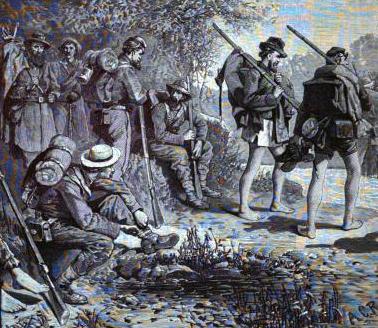
"Colonel [E.V.] White's battalion of cavalry was ordered to report to me for this expedition, and on the morning of the 26th, having sent all my trains to Chambersburg, excepting the ambulances, one medical wagon for a brigade, the regimental ordnance wagons, one wagon with cooking utensils for each regiment, and fifteen empty wagons to gather supplies with, and carrying no other baggage, I moved toward Gettysburg, and on reaching the forks of the road, about 1½ miles from Cashtown, I sent General Gordon, with his brigade and White's battalion of cavalry, on the pike through Cashtown toward Gettysburg, and moved with the rest of the command to the left, through Hilltown to Mummasburg. I had heard on the road that there was probably a force at Gettysburg, though I could get no definite information as to its size, and the object of this movement was for Gordon to amuse and skirmish with the enemy while I should get on his flank and rear, so as to capture his whole force.
"On arriving at Mummasburg, I ascertained that the force at Gettysburg was small, and while waiting here for the infantry to come up (whose march was considerably delayed by the muddy condition of the roads), a company of French’s cavalry that had been sent toward Gettysburg captured some prisoners, from whom it was ascertained that the advance of Gordon’s force (a body of cavalry from White’s battalion) had encountered a regiment of militia, which fled at the first approach, and I immediately sent forward Colonel French with his cavalry to pursue this militia force, which he did, capturing a number of prisoners. Hays’ brigade on arriving was also dispatched toward Gettysburg, and the other brigades with the artillery were halted and encamped near Mummasburg.
"I then rode to Gettysburg, and found Gordon just entering the town, his command having marched more rapidly than the other brigades, because it moved on a macadamized road. The militia regiment which had been encountered by White’s cavalry was the Twenty-sixth Pennsylvania Militia, consisting of 800 or 900 men, and had arrived in Gettysburg the night before, and moved that morning a short distance out on the road toward Cashtown, but had fled on the first approach of White’s cavalry, taking across the fields between Mummasburg and Gettysburg, and going toward Hunterstown. Of this force, 175 prisoners in all were captured and subsequently paroled. Hays’ brigade was halted, and encamped about a mile from Gettysburg, and two regiments were sent to aid French in the pursuit of the fugitive militia, but could not get up with it.
"The authorities of Gettysburg declared their inability to furnish any supplies, and a search of the stores resulted in securing only a very small quantity of commissary supplies, and about 2,000 rations were found in a train of cars, and issued to Gordon’s brigade. The cars, numbering 10 or 12, were burned, as was also a small railroad bridge near the place. There were no railroad buildings of consequence. The day was rainy and the roads very muddy, and as it was late when I reached the place, and having to move upon York early next day, I had no opportunity of compelling a compliance with my demands in this town, or ascertaining its resources, which I think, however, were very limited."
Report of Gen. Jubal Early, 27 O.R. (II) 464-65.
According to Gen. Gordon :
"Crossing the Potomac at Shepherdstown on June 22, we marched through Boonsborough, Md., to Gettysburg, Pa. [M]y brigade was detached by Major-General Early from the division, and ordered on a different road, with a battalion of cavalry, under the command of Lieutenant-Colonel [E. V.] White. In front of Gettysburg, a regiment of Pennsylvania militia was charged and routed by this cavalry battalion."
Report of Gen. John B. Gordon, 27 O.R. (II) 491.
The militia regiment was the 26th (Pennsylvania) Regiment of Emergency Militia Infantry. Per Dyer's Compendium of the War of the Rebellion, the unit was organized at Harrisburg 22 June 1863 for the protection of Pennsylvania against Lee's invasion. Its duty was in the Department of the Susquehanna, near Gettysburg, Pa., June 26. It was mustered out 31 July 1863. This unit was no match for a veteran cavalry battalion.
The Caledonia Iron Works,
now a state parkCaledonia State Park is the location of an iron mill once owned by Thaddeus Stevens. In 1863, it was the site of a self-contained village. The Caledonia Iron Works included a large charcoal furnace, rolling mill and associated buildings, stables, storehouses, a company store and cottages for its 200 workers and their families. Confederate cavalry from Albert Jenkins' brigade had visited the furnace on June 16. In return for the impressment of forty horses and mules belonging to the works, the furnace was not torched.
What a difference a week makes. On 26 June 1863, business manager John Sweeney at Caledonia heard rumors that Confederates were threatening to burn the furnace. He located General Early and tried to talk his way out of the destruction. The furnace was unprofitable, he said. His boss, Thaddeus Stevens, would have closed the place years ago if he hadn’t cared so much for its poor workers and their families. If southerners burned the furnace, said Sweeney, all these dependent families would suffer.
"That is not the way Yankees do business," retorted the general. "They do not go on unless they make money. Then, Mr. Stevens is an enemy of the South. He is in favor of confiscating their property and arming the Negroes. His property must be destroyed."
And destroyed it was. Colonel Milton J. French's 17th Virginia Cavalry [Battalion] burned all the company buildings to the ground and smashed the windows in the workers' cottages. Confederates looted the company store, taking provisions worth perhaps $10,000, hauled away all of the bar iron, appropriated the corn and grain in the mills and destroyed eight tons of grass used for fodder. "They could not have done the job much cleaner," Stevens later lamented. "It is rather worse than I expected."
On July 1st General Robert E. Lee rode past the ruins of the furnace on his way to Gettysburg. Upset at the destruction, he told Mr. Sweeney that the families who had suffered could be supplied by the general's own commissary director.
March Home / History About The Original March / The Recreated March / Registration
Ad Hoc home / At High Tide home
Gettysburg: forecast
This page hosted by Silas Tackitt and was last updated on 04 May 2008 20:05
 March
to the next page.
March
to the next page.